“`html
Table of Contents
Introduction
The web development industry is entering a new phase driven by agentic AI systems, autonomous workflows, and intelligent development platforms. In 2026, developers are no longer using AI only for autocomplete suggestions or chatbot integrations. Instead, AI agents are becoming active collaborators capable of planning tasks, interacting with APIs, analyzing codebases, debugging applications, and even deploying production-ready software.
Recent technology trends show that AI-assisted development, Model Context Protocol (MCP) integrations, browser automation, and AI-native workflows are rapidly becoming standard practices across startups and enterprise engineering teams. Industry discussions around agentic systems have accelerated due to the growth of advanced coding assistants, AI orchestration platforms, and multi-agent development environments. According to several reports and technology trend analyses, AI-powered developer workflows are among the fastest-growing segments in software engineering. ([crossover.com](https://www.crossover.com/resources/11-best-web-development-trends-for-2026?utm_source=openai))
This shift is not just another productivity trend. It represents a fundamental change in how applications are built, tested, maintained, and scaled.
What Is Agentic AI?
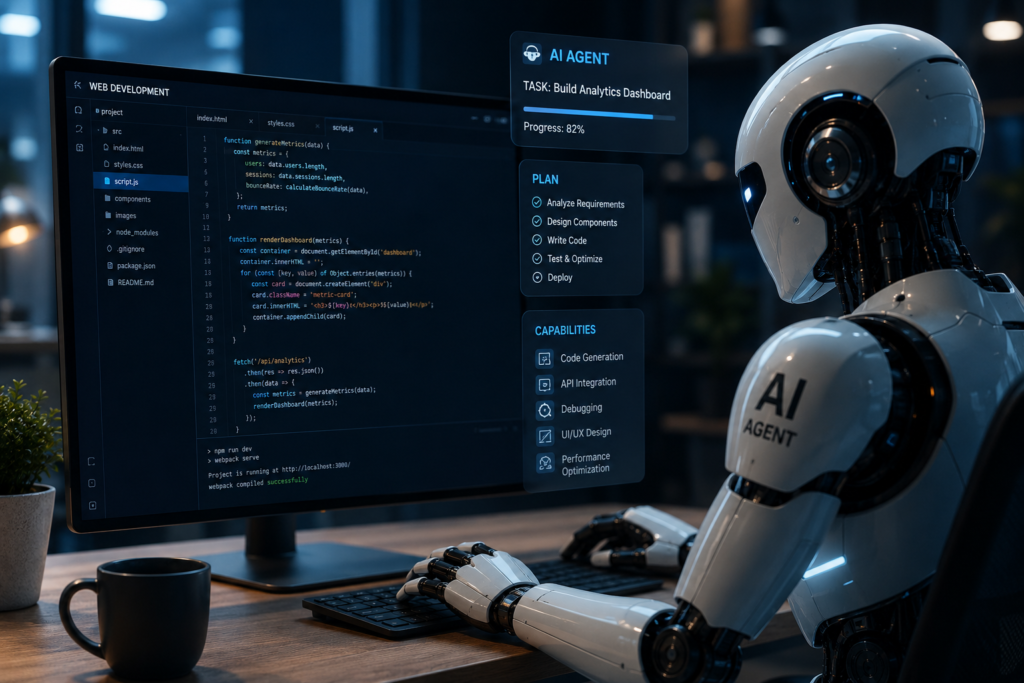
Agentic AI refers to AI systems capable of performing multi-step tasks autonomously with limited human intervention. Unlike traditional AI assistants that simply respond to prompts, agentic systems can:
- Plan objectives
- Execute workflows
- Use external tools
- Interact with APIs
- Access databases
- Monitor outcomes
- Iterate based on results
For example, a modern AI development agent can receive a request such as:
“Build a responsive analytics dashboard using React, connect it to a PostgreSQL database, deploy it to Vercel, and generate API documentation.”
Instead of returning only code snippets, the agent can break the project into steps, generate files, configure dependencies, run tests, and deploy the application automatically.
Platforms such as AI-native IDEs, autonomous coding assistants, and browser-integrated AI systems are rapidly pushing this concept into mainstream development workflows. ([agenticthinking.ai](https://agenticthinking.ai/blog/ai-dev-toolkit-2026/?utm_source=openai))
Why Agentic AI Is Becoming a Major Web Development Trend
1. Faster Development Cycles
AI-assisted coding tools have already improved developer productivity significantly. Agentic AI expands this advantage by automating repetitive engineering tasks such as:
- Code scaffolding
- Testing
- Documentation generation
- Bug fixing
- Dependency management
- UI generation
- API integration
Instead of spending hours on setup and boilerplate code, developers can focus more on architecture, product logic, security, and user experience.
2. Rise of AI-Native Development Environments
Traditional development environments are evolving into AI-powered workspaces where agents actively participate in software engineering processes. Modern IDEs increasingly support autonomous workflows, allowing developers to delegate entire tasks to AI systems.
Tools like AI-enhanced coding environments and agent-driven platforms now integrate editors, terminals, browsers, deployment pipelines, and testing systems into unified AI-assisted workflows. ([en.wikipedia.org](https://en.wikipedia.org/wiki/Codex_%28AI_agent%29?utm_source=openai))
3. Increased Demand for Rapid Prototyping
Businesses are under pressure to launch digital products faster than ever. Startups, SaaS companies, and enterprise teams are adopting AI agents to accelerate MVP creation and reduce development costs.
AI-generated interfaces, backend logic, and automated deployment pipelines allow teams to validate ideas in days instead of months.
4. Multi-Agent Collaboration
One of the most exciting developments in 2026 is the emergence of collaborative AI systems. Instead of relying on a single assistant, organizations are building ecosystems of specialized AI agents.
For example:
- A frontend agent handles UI generation
- A backend agent manages APIs
- A security agent scans vulnerabilities
- A DevOps agent deploys infrastructure
- A QA agent runs automated testing
This collaborative approach mirrors real engineering teams while significantly improving scalability and efficiency.
The Role of MCP (Model Context Protocol)
One of the most influential technologies behind agentic AI workflows is MCP, or Model Context Protocol. MCP acts as a universal interface that enables AI systems to connect with external tools, applications, APIs, databases, and services.
Instead of building custom integrations for every platform, developers can use MCP-compatible systems to create standardized communication between AI agents and software environments.
According to emerging industry discussions and AI engineering reports, MCP adoption is rapidly increasing because it simplifies interoperability across AI ecosystems. ([digitalapplied.com](https://www.digitalapplied.com/blog/ai-agent-protocol-ecosystem-map-2026-mcp-a2a-acp-ucp?utm_source=openai))
Benefits of MCP in Web Development
- Standardized AI integrations
- Improved workflow automation
- Better context management
- Simplified tool connectivity
- Reduced development overhead
- Cross-platform compatibility
This standardization is expected to become a foundational layer for the next generation of AI-powered web applications.
How Agentic AI Is Changing Frontend Development
AI-Generated Interfaces
Modern AI systems can generate complete frontend layouts using natural language prompts. Developers can describe desired functionality, styling preferences, or user flows, and AI agents generate production-ready UI components.
These systems often support:
- Responsive design
- Accessibility optimization
- Component libraries
- Dark mode support
- Animation generation
- Cross-browser compatibility
Frameworks like React, Next.js, Vue, and Svelte are increasingly being paired with AI-driven design systems.
Smarter User Experiences
AI agents are also improving personalization within web applications. Modern platforms can dynamically adapt interfaces based on user behavior, engagement patterns, and predictive analytics.
Examples include:
- AI-powered recommendations
- Adaptive navigation systems
- Personalized dashboards
- Real-time content optimization
- Intelligent search experiences
Backend Development Is Becoming More Autonomous
Backend engineering is experiencing significant transformation through AI automation.
Agentic systems can now:
- Create API endpoints
- Generate database schemas
- Optimize queries
- Write authentication systems
- Configure cloud infrastructure
- Monitor server performance
- Identify scalability bottlenecks
Cloud-native development is particularly benefiting from AI automation because modern infrastructure relies heavily on configuration-based workflows that AI systems can manage effectively.
AI and DevOps Integration
DevOps pipelines are becoming increasingly autonomous. AI agents can monitor deployments, identify errors, roll back failed updates, and optimize infrastructure allocation automatically.
This trend is especially important for organizations managing large-scale distributed systems.
The Growing Importance of Browser Automation
Browser automation is another major trend connected to agentic AI.
Modern AI systems can interact directly with websites and web applications, allowing them to:
- Navigate interfaces
- Submit forms
- Collect information
- Execute workflows
- Perform testing procedures
- Complete repetitive tasks
Several browser vendors and AI companies are actively investing in AI-powered browsing experiences and autonomous web interactions. ([windowscentral.com](https://www.windowscentral.com/microsoft/microsoft-edge-copilot-mode-announcement-agentic-ai-web-browser?utm_source=openai))
This evolution could fundamentally change how users interact with digital products in the coming years.
Security Challenges in the Agentic AI Era
While agentic AI offers significant benefits, it also introduces new security concerns.
1. AI-Generated Vulnerabilities
Automatically generated code can sometimes include insecure dependencies or flawed logic. Developers must carefully review AI-generated output before deployment.
2. Prompt Injection Attacks
AI systems interacting with external content may become vulnerable to malicious instructions hidden within websites, APIs, or datasets.
3. Over-Automation Risks
Allowing autonomous systems to control infrastructure without oversight can increase operational risks.
Organizations should implement:
- Human review processes
- Permission controls
- Audit logging
- Security testing pipelines
- AI governance frameworks
Security-first AI engineering is becoming one of the most important priorities for enterprise technology teams.
How Developers Should Adapt
The rise of agentic AI does not eliminate the need for developers. Instead, it changes the nature of software engineering work.
Developers who thrive in this environment will focus more on:
- System architecture
- AI orchestration
- Workflow design
- Security engineering
- Product strategy
- Data modeling
- Human-AI collaboration
The future developer role increasingly resembles an engineering conductor who coordinates AI systems rather than manually writing every line of code.
Business Impact of Agentic AI
Businesses adopting AI-native development workflows are already experiencing measurable benefits:
- Reduced development costs
- Faster release cycles
- Improved scalability
- Enhanced customer experiences
- Better operational efficiency
- Accelerated innovation
Startups can launch products with smaller teams, while enterprises can modernize legacy systems more efficiently.
Organizations that successfully integrate AI agents into development workflows may gain significant competitive advantages over slower-moving competitors.
The Future of Web Development
The next phase of web development will likely revolve around AI-native ecosystems where applications are built collaboratively between humans and intelligent agents.
Emerging trends expected to grow further include:
- Autonomous development agents
- AI-powered browser interfaces
- Natural language programming
- AI-driven testing systems
- Agent-to-agent communication protocols
- Self-healing infrastructure
- AI-generated SaaS platforms
As standards like MCP continue evolving, interoperability between AI systems will improve dramatically.
The result could be a new generation of intelligent applications capable of adapting, optimizing, and evolving continuously.
Conclusion
Agentic AI is rapidly becoming one of the most transformative forces in web development and software engineering. What began as AI-assisted coding has evolved into autonomous systems capable of handling complex workflows across frontend development, backend engineering, DevOps, testing, and infrastructure management.
The combination of AI agents, MCP integrations, browser automation, and AI-native development platforms is reshaping how digital products are created and maintained.
Developers and organizations that embrace these technologies early will likely gain substantial productivity advantages while unlocking entirely new approaches to software innovation.
Although challenges around security, governance, and reliability remain, the momentum behind agentic AI is accelerating quickly. The web development landscape of 2026 is no longer just about building applications. It is increasingly about orchestrating intelligent systems that build, optimize, and evolve applications alongside human teams.
For additional reading on emerging web development technologies and AI workflows, developers can explore resources from
Figma,
Agility CMS, and
Crossover.
“`